
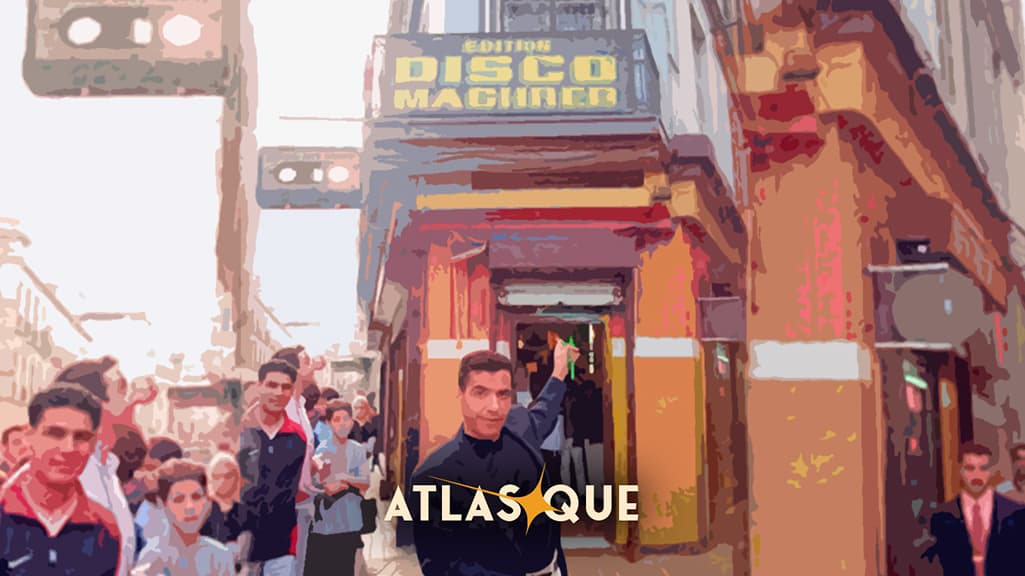
How do we explain to another culture that we vibe to police sirens?
PRESS PLAY
Your first Raï concert was probably a wedding.
Do you remember?
It’s one in the morning, the speakers are too loud, your aunt is already on her third outfit, and the children have disappeared between the buffet and the dance floor. You are either running around with your cousins through a sea of plastic chairs or asleep in one, while Cheb Houssem, Cheb Bilal, or whoever the DJ has decided will carry the night is singing about a heartbreak we were far too young to understand.
We didn’t know the weight of the words yet, but we knew the feeling. Raï meant the wedding had started. It was in weddings and summer evenings, in cars and cafes, and in the background of family gatherings. Raï was the heartbeat of our celebrations.
So, I find it strange that somewhere between those cassette-woven memories and adulthood, we looked at the same music that soundtracked our joys and decided it belonged only to our parents. Not us. We had newer things, more international, cooler.
And ordinary wasn’t cool anymore.
REWIND — “Ya Rayi”
Before Raï became the music playing in the background of our childhood, it was a genre that spent decades refusing to stay in the background.
Born in Western Algeria, echoing off the limestone streets and humid alleys of Wahran, it grew from vernacular poetry and ancient bedouin rhythms. These were shaped fearlessly by the Cheikhat, women whose voices gave space to subjects that society didn’t always make room for: love, desire, heartbreak, frustrations. Even the word itself is telling: Raï means opinion, point of view, a stubborn way of saying this is what I think. The old ya Raï was almost an invitation—or a warning—to listen.
And then came the Cheb and Chebba: the young ones. It reads almost like fiction on paper; a genre built entirely around having something to say, continuously being torn apart and reinvented by the young.
Raï was never interested in behaving itself anyways.
It talked about things people weren't always supposed to talk about. It made room for complicated relationships, desire, disappointment, and the frustrations of ordinary life. Raï was trying to be honest.
And I guess honesty becomes less impressive when it speaks your language.
TRACK 02 — “DIDI”
Then came the cassette tape, handed from palm to palm, packed in an overloaded suitcase and crossed borders.
Just like that, the Algerian diaspora carried it across the Mediterranean, and eventually across the world. Artists like Khaled, Mami, and Rachid Taha helped take the frantic sound from Oran and dropped it straight in Paris, Marseille and beyond. Suddenly, people who had never set foot in Algeria were vibing to Raï. They didn’t always understand the lyrics, but apparently heartbreak doesn’t require subtitles.
So, Didi travelled. The sound spilled out into the world.
And between Algeria and the rest of the world, Raï became part of how the country sounded from the outside, living proof that our culture could fill stadiums.
Which makes it all the more ironic, because back home, some people decided that it wasn’t sophisticated enough to listen to.
FLIP THE TAPE — “Wahran, Wahran…”
That global triumph contrasted sharply with how we started treating the music locally. At some point, Raï was shoved into the box of social embarrassment. It became what our parents listened to, it became weddings and family gatherings; a soundtrack of ordinary Algerian life, and we convinced ourselves we had outgrown it. It became cringe and “un-cool.”
Meanwhile, dropping names like rock, rap, or American pop could make you sound cultured, modern, and international. “I listen to Cheb Bilel” could get you a totally different reaction. Uncultured? Vulgar? Unsophisticated? Assumptions piled on top of assumptions, built on class anxiety and cultural self doubt.
The judgment was more about what the music represented. Raï speaks in Derja; the language we use at home, in arguments, and in jokes. The language that doesn't always receive the same prestige as French, English, or formal Arabic.
We learn very early that some things make us look sophisticated and other things make us look ordinary. And in a country where French and English can carry associations of education, modernity and global belonging, local culture can start feeling almost too intimate.
We wanted to look outward, when Raï kept pointing home.
TRACK 04 — “YA RAYAH”
But now? The timeline loops back.
On TikTok, grainy vinyl cuts, yellowish filters, and modern remixes bleed into the background of millions of short-form videos overnight. Gen Z kids who weren’t even born when Hasni, one of the voices that were silenced in the mid-nineties, are now lip-syncing his lyrics with a fierce, sudden territorial pride. A new wave of producers are fusing classic synthesized lines with trap drums and club electronica, creating a hyper-modern pulse that hits festival stages from Paris to Montreal.
Yet calling it a “comeback” feels hollow, almost insulting. How can you resurrect something that was never buried? Raï didn't return from the dead; it just waited patiently in the static of the glovebox while we grew up enough to finally hear it again. The generation who would listen to American pop and Warda Charlomanti in the same playlist. Who can love K-pop and Hasni. Who can speak English online and Derja at home. And who don't necessarily see those identities as competing anymore.
And that changes what Raï means.
PRESS STOP — AND PLAY IT AGAIN
Was Raï ever uncool?
I think it never was. We were just too busy trying to fit into a world that never understood us, running away from the very sound that had the courage to tell our truth.
Because at the end of the day, trends fade, genres get sanitized, and cool kids grow old. But the tape? The tape was always spinning.
We just finally stopped speeding, rolled down the window, and pressed play again.